





What Is Datura?
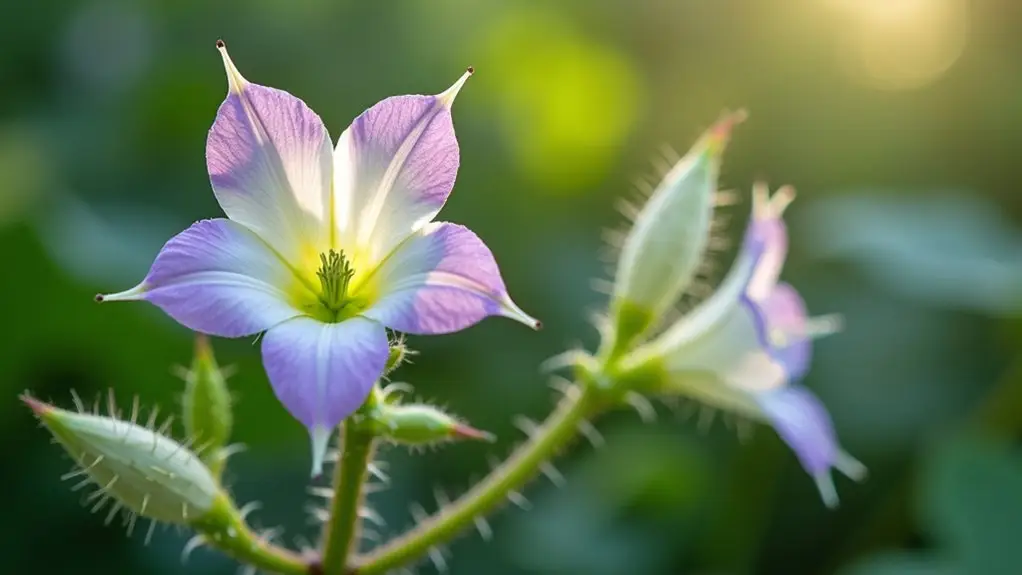
How does a plant become both admired for its beauty and feared for its danger? You’ll find the answer in datura, a genus of flowering plants belonging to the Solanaceae family. The datura plant produces large, trumpet-shaped blooms that attract nocturnal pollinators, yet every part contains potent tropane alkaloids including atropine and scopolamine.
How does a plant become both admired for its beauty and feared for its danger? You will find the answer in datura, a genus of flowering plants belonging to the Solanaceae family. The datura plant produces large, trumpet-shaped blooms that attract nocturnal pollinators, yet every part contains potent tropane alkaloids, including atropine and scopolamine, compounds responsible for the serious datura plant toxicity risks associated with accidental exposure or ingestion.
What is a datura plant exactly? You’re looking at herbaceous annuals or short-lived perennials that reach heights of 1.5 to 2 meters. The datura flower displays striking funnelform petals in white, yellow, pink, or purple hues. Following pollination, spiny capsules develop containing numerous datura seeds that remain viable for years. These flattened, tan or brown seeds disperse readily across pastures and wastelands, contributing to the plant’s invasive potential. The genus comprises approximately 9 species that commonly grow along roadsides and other disturbed habitats throughout warm regions of the world. Due to its toxicity, datura is highly poisonous to humans and stock, making it a significant concern for agricultural areas and gardens alike.
Datura vs. Brugmansia: The Key Differences
Although gardeners and botanists often confuse datura with brugmansia, you can distinguish these genera through several reliable morphological characteristics. Both belong to the solanaceae family and represent toxic flora within nightshade plants, yet taxonomists formally separated them in 1973.
You’ll notice the most definitive difference in flower orientation. Datura, including datura stramonium (commonly called jimson weed or devil’s trumpet plant), produces upright, bell-shaped blooms pointing skyward. Brugmansia flowers hang pendulously downward. The common name “angel’s trumpet” is used interchangeably for both genera, which contributes to ongoing confusion among gardeners.
Growth habits further differentiate these datura nightshade relatives. Datura develops as herbaceous shrubs reaching 2-6 feet, while brugmansia forms woody, tree-like structures up to 30 feet. Examine the fruit for confirmation: datura produces spiny, dehiscent seed capsules that split open, whereas brugmansia bears smooth, non-dehiscent fruits lacking thorns. Additionally, brugmansia plants may change color and shape during their first three years of growth, while datura maintains a consistent appearance throughout its lifecycle.
How to Identify Datura Flowers
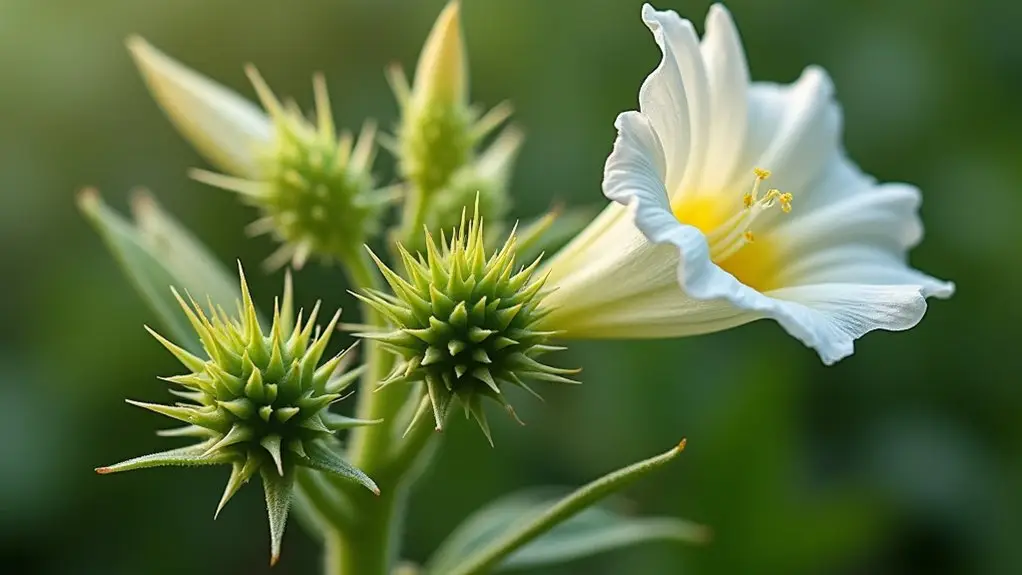
When examining datura specimens in the field, you’ll find their distinctive trumpet-shaped flowers serve as the most reliable identification markers. The devil’s trumpet plant displays a funnelform perianth with five fused petals forming an elongated tube measuring 50, 100 mm in length. These solitary blooms appear erect or spreading from leaf axils and branch terminals.
Key morphological features for accurate identification include:
- Corolla structure: Five shallow lobes terminate in slender tooth-like projections at petal tips
- Coloration patterns: Predominantly, chiefly, mainly, or largely white with purple-tinged throats or lavender markings varying by species
- Calyx characteristics: Tubular structure exceeding 2 inches with five pointed lobes
You’ll observe these nocturnal flowers opening at dusk and withering by midday. These night-opening flowers are pollinated by Sphinx moths, which are attracted to the blooms during evening hours. The superior ovary and five stamens with 3, 4 mm anthers confirm taxonomic placement within Solanaceae. Following pollination, the flower develops into an egg-shaped seed capsule that can be spiny or smooth and contains many glossy black seeds.
Datura Flower Colors From White to Purple
Rare cultivars demonstrate expanded chromatic ranges. Datura Golden Flames produces unusual golden-yellow flowers, while hybrid varieties exhibit peach blushes and lilac frilled petals. Trumpet dimensions vary from 5-20 cm in length, with coloration intensity influenced by soil composition and light exposure. The species Datura inoxia produces cream, pink, and lavender tubular flowers that can reach 7 to 8 inches in length. Datura Discolor features attractive purple throats that create a striking contrast against its snow-white trumpet-shaped blooms.
The Spiny Seedpod That Gives Datura Its Name
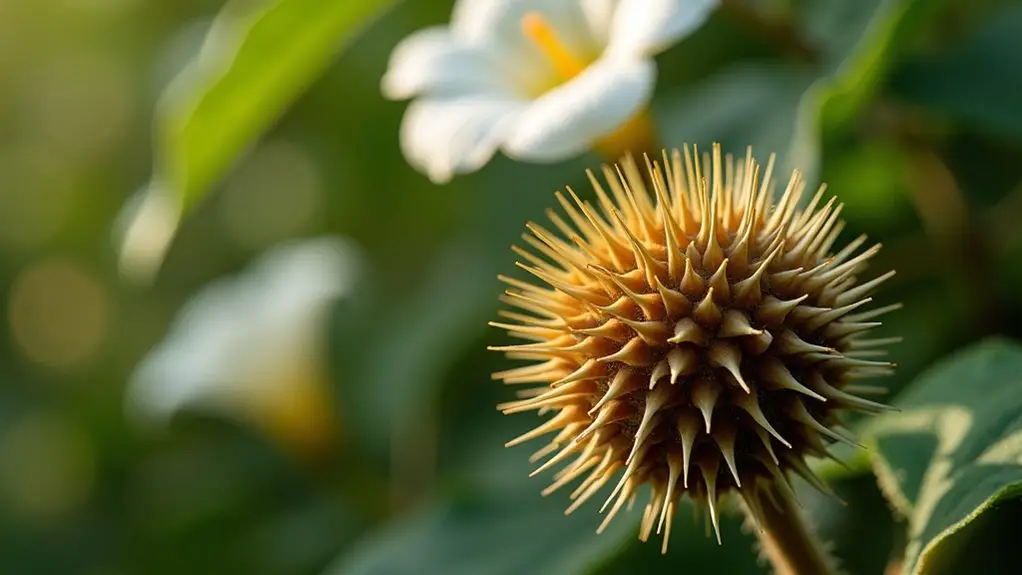
Beyond the trumpet-shaped flowers, datura produces a distinctive fruit structure that earned the genus its common name “thornapple.” The spiny capsule, a globular structure covered in sharp prickles, develops from fertilized flowers and serves as the plant’s seed-bearing organ.
You’ll find species-specific variations in capsule morphology:
- *D. stramonium* and *D. inoxia*: sharp, spiky spines covering the surface
- *D. metel*: knobby, less pronounced projections
- *D. wrightii*: walnut-sized spherical capsules with prominent spines
When examining the devil’s trumpet plant, you’ll notice capsules measuring 1 to 1¾ inches long, held erect on straight stalks. At maturity, each datura fruit splits into four equal segments, releasing numerous flattened seeds. These tan to black seeds, approximately 4 mm long, remain viable in soil for decades and can be dispersed by wind, sometimes appearing unexpectedly in gardens far from established populations. The greatest diversity of species is found in Central America and Mexico, where these distinctive seedpods have evolved across varied habitats.
What Do Datura Seeds Look Like?
The devil’s trumpet plant produces seeds with a dull, pitted surface marked by prominent wrinkles. Coloration ranges from dull black to brown, with immature specimens appearing lighter. A triangular hilum measuring approximately 1.0 mm features white to pinkish tissue with a small bump at its base.
*D. wrightii* seeds are significantly larger, measuring 4-6 mm in length with brown to red-brown coloration. Vigorous datura plants generate 600-700 seeds per capsule, which disperse when the spiny, egg-shaped pods split open at maturity. The fruit capsule containing these seeds measures 4, 10 cm long and 2, 6 cm broad. Jimsonweed seeds measure 2.5 – 4.0 mm in length and share a similar rounded D-shape, pitted surface, and black coloration.
Datura Leaves: Lobed Edges and Coarse Teeth
You’ll notice datura leaves display an ovate to elliptic shape, measuring 50, 210 mm in length and 40, 150 mm in width, with the blade widest below or near the middle. The margins feature distinctive lobed edges combined with coarse, outward-pointing teeth, a key taxonomic identifier across *Datura* species. These leaves attach alternately along the stem via petioles measuring 35, 50 mm, with bases that are often asymmetrical and either cordate or cuneate in form. The leaves appear green with a gray sheen due to short, whitish hairs, and when crushed, they emit an unpleasant odor. Handle these leaves with care, as contact with the plant can cause contact dermatitis in sensitive individuals.
You will notice datura leaves display an ovate to elliptic shape, measuring 50, 210 mm in length and 40, 150 mm in width, with the blade widest below or near the middle. The margins feature distinctive lobed edges combined with coarse, outward-pointing teeth, a key taxonomic identifier across Datura species. These leaves attach alternately along the stem via petioles measuring 35, 50 mm, with bases that are often asymmetrical and either cordate or cuneate in form. The leaves appear green with a gray sheen due to short, whitish hairs, and when crushed, they emit an unpleasant odor. Handle these leaves with caution, as contact with the plant can cause contact dermatitis in sensitive individuals and reflects the broader toxicity levels of datura use, even without ingestion.
Leaf Shape and Size
Datura leaves exhibit considerable morphological variation, though most species produce ovate to elliptical leaf blades measuring 50, 210 mm in length and 40, 150 mm in width. You’ll find that datura specimens typically display leaves widest near or below the middle, tapering at both ends. The devil’s trumpet plant can produce foliage reaching up to 254 mm in length. The leaves appear smooth with a soft, irregularly undulated surface texture along the margins.
When examining leaf dimensions, you should note these key characteristics:
- Leaf blades range from 76, 152 mm (3, 6 inches) in many common species
- Width measurements span 40, 150 mm across the blade
- Larger specimens may reach 200 mm or more in ideal growing conditions
Petioles measure 35, 50 mm in length, attaching at the basal margin with a narrow base where they connect to the stem.
Stem Characteristics Overview
Along the blade margins, datura leaves display distinctive lobed or toothed edges that serve as key identification features. You’ll observe large, coarse teeth projecting outward from the blade, often combined with shallow, pointed lobes arranged in rows along each side of the central axis.
When examining devil’s trumpet plant specimens, you’ll notice considerable variation among species. *D. stramonium* exhibits both teeth and lobes, while *D. inoxia* presents lobed or toothed margins on gray-green foliage. *D. metel* shows smooth to wavy toothed edges, and *D. discolor* features triangular leaves with pronounced coarse margins.
The margin texture of datura leaves typically appears sinuate with a wavy quality enhanced by irregular dentation. You won’t find spines along these edges, though the toothed structure creates a rough tactile quality with membranaceous texture.
Datura Stems: Green to Purple and Many-Branched
Key stem characteristics include:
Branching patterns, texture, and cross-section shape reveal essential clues for distinguishing between Datura species in the field.
- Branching pattern: Forked, many-branched structure creating dense growth, with flowers arising at branch divisions
- Smooth to slightly pubescent texture, hairless between nodes in mature specimens
- Circular cross-section without wings, tendrils, or nodal swelling
You’ll find stems measuring 30 cm to 1.5 m in length, appearing robust and thick. Datura discolordisplays grayish-green coloration, while *D. inoxia* maintains an upright habit reaching heights of 5 feet.
How to Tell Datura Species Apart
You can distinguish Datura species by examining seed hilum morphology and corolla dimensions. D. stramonium displays a triangular hilum with straight edges and a small bump below, while D. ferox exhibits an oval hilum with rounded edges and no bump. Corolla size further separates species into two groups: those with 7-10 cm corollas bearing 5 teeth versus those with 16-24 cm corollas displaying either 5 or 10 teeth.
Seed and Hilum Differences
Seed morphology provides reliable diagnostic characters for distinguishing Datura species when vegetative features prove inconclusive. You’ll find considerable variation in seed shapes across the genus, ranging from circular to rectangular, reniform, and triangular reniform configurations. Seeds typically measure 3, 5 mm in length and 2.5, 4.0 mm in width, with bilateral flattening.
Hilum characteristics offer particularly valuable taxonomic markers:
- Long triangular or regular triangular configurations indicate specific species
- T-shaped hilum formations distinguish certain taxa
- White, protruding hilums with residual suspensor tissue provide diagnostic evidence
You’ll notice the seed surface texture varies from smooth-edged to wavy-ridged, with leathery integuments ranging from light yellow to dark brown. Internal anatomy reveals abundant white endosperm and mainly annular or curved embryos, rarely exhibiting straight configurations.
Corolla Size and Teeth
Where Datura Grows: Roadsides and Waste Areas
Datura species exhibit a strong preference for disturbed habitats, particularly roadsides and waste areas where human activity has altered the natural terrain. You’ll find these herbaceous annuals thriving in environments ranging from temperate to tropical zones, where their distribution has expanded through naturalization processes. Datura how long last can vary significantly depending on environmental conditions and the specific species in question. Some may bloom for several days, while others have a shorter duration of flowering, contributing to the plant’s appeal and unique lifecycle. Understanding these factors is crucial for gardeners and botanists alike who wish to manage or utilize Datura effectively in their respective areas.
Datura thrives where humans have disturbed the land, roadsides, waste areas, and altered terrain from temperate to tropical zones.
The genus demonstrates remarkable adaptability to marginal growing conditions:
- Tolerates poor, disturbed soils along transportation corridors
- Self-seeds aggressively in open ground, promoting invasive spread
- Produces viable seeds that persist in soil seed banks for years
When surveying potential datura habitat, you should examine fields, pastures, and wasteland areas. The plants reach heights up to 2 meters and display characteristic bushy growth patterns from many-branched stems. Their foul-smelling foliage serves as a natural deterrent in wild populations.
Frequently Asked Questions
Is Datura Poisonous to Dogs, Cats, and Other Household Pets?
Yes, Datura’s highly toxic to your dogs, cats, and other household pets. The plant contains tropane alkaloids, atropine, scopolamine, and hyoscyamine, concentrated in seeds and leaves. If your pet ingests even small amounts, you’ll observe anticholinergic syndrome: mydriasis, tachycardia, ataxia, and gastrointestinal distress. Dogs face lethal risks at doses exceeding 3 g/kg body weight. You should immediately contact your veterinarian if you suspect exposure, as symptoms can progress to respiratory failure and coma.
How Long Does It Take for Datura Seeds to Germinate?
Datura seeds typically germinate within 7-42 days, depending on the species and environmental conditions you provide. For *Datura metel*, you’ll observe emergence between 21-42 days, while other varieties may sprout in 1-3 weeks. You’ll achieve excellent germination rates by maintaining temperatures between 65°-75°F (18-30°C). Pre-soaking seeds in lukewarm water for 24 hours enhances germination success. Higher temperatures and neutral pH levels greatly improve your germination outcomes.
Can Touching Datura Leaves Cause Skin Irritation or Allergic Reactions?
Yes, touching Datura leaves can cause skin irritation and allergic reactions. The plant’s tropane alkaloids may trigger contact dermatitis, producing burning sensations and occasional blistering. You’ll find individual sensitivity varies considerably, some people experience pronounced reactions while others show minimal symptoms. The leaves contain significant alkaloid concentrations, making dermal absorption a legitimate concern. You should always wear protective gloves when handling any Datura species and wash your hands thoroughly afterward.
What Should You Do if Someone Accidentally Ingests Datura Plant Material?
You should call emergency services immediately if someone ingests Datura stramonium or related species. Don’t induce vomiting due to aspiration risk. Rinse the person’s mouth with water if they’re conscious and cooperative. Monitor their respiratory rate and cardiac rhythm closely while awaiting medical assistance. Document the estimated ingestion time and quantity consumed. Clinical intervention typically involves activated charcoal administration, physostigmine for anticholinergic toxidrome reversal, and benzodiazepines for seizure management.
Are There Any Legal Restrictions on Growing Datura in Home Gardens?
You’ll find legal restrictions on Datura cultivation vary considerably by jurisdiction. In the United States, regulations differ by state, Michigan classifies Datura stramonium as a restricted noxious weed under Regulation No. 715. Internationally, India prohibits cultivation under the Drug & Cosmetic Act 1940. Australia, South Africa, and North America designate it as a noxious weed due to its invasive characteristics. You should verify your local and state regulations before cultivating any Datura species.