




HHC vs THC: Which Is Right for You?

When choosing between HHC and THC, understanding their receptor interactions clarifies why each produces distinct effects. HHC binds weaker to CB1 receptors, delivering approximately 70-80% of delta-9 THC’s potency. So is HHC stronger than THC? No, THC consistently produces more intense euphoria and altered perception.
When comparing the HHC high vs THC, you’ll notice HHC offers a clearer-headed, functional experience with reduced anxiety risk. How strong is HHC compared to THC depends on your dosage and individual factors, but expect milder cognitive impairment and lighter physical effects. The lack of regulation surrounding HHC products means the synthesis process can introduce contaminants or impurities, making quality verification essential before use. HHC’s added hydrogen atoms through the hydrogenation process give it increased stability compared to THC.
If you’re a beginner or prefer predictable, sustained effects, HHC suits your needs. If you’re seeking potent pain relief or stronger psychoactive experiences, THC remains the better choice in the HHC vs THC comparison.
The Core Difference: HHC’s Missing Double Bond
Although HHC and delta-9 THC share nearly identical molecular structures, a single chemical distinction fundamentally alters how each compound interacts with your endocannabinoid system.
Delta-9 THC contains a double bond at the ninth carbon position in its central ring. HHC lacks this double bond entirely, hydrogenation saturates it, adding two hydrogen atoms to the molecular structure. This seemingly minor change profoundly impacts receptor engagement. The hydrogenation process also makes HHC more stable with a longer shelf life and less prone to degradation compared to THC. Additionally, HHC demonstrates greater resistance to heat and UV radiation than THC, further contributing to its superior stability.
When you consume HHC, it binds more weakly to CB1 receptors than delta-9 THC. The saturated ring structure reduces binding affinity, resulting in diminished potency and bioavailability. HHC exists as two epimers: (9R)-HHC demonstrates superior CB1 receptor affinity compared to (9S)-HHC, meaning your experience depends partly on epimer ratios in your product. This weaker receptor activation translates directly to the milder, smoother psychoactive profile users report.
Is HHC as Strong as THC?
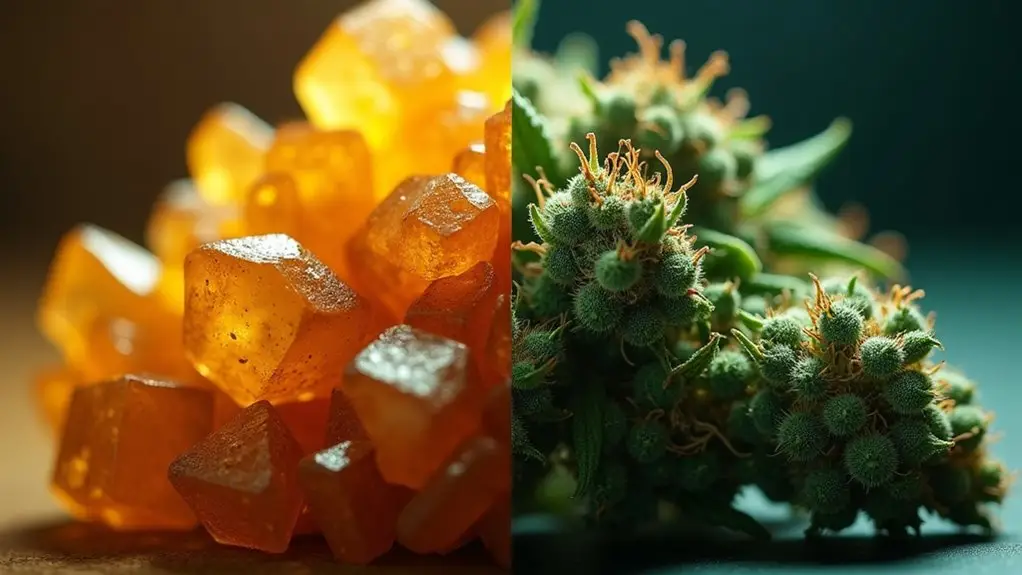
Because HHC binds to CB1 receptors with reduced affinity compared to delta-9 THC, its potency falls within a 30, 80% range depending on isomer composition. The 9β-HHC (9R) isomer demonstrates binding similar to delta-9 THC, while 9α-HHC shows approximately 10 times less receptor activation. Commercial products contain 15, 70% of the more potent 9R form, creating significant variability in experienced strength.
When comparing HHC potency vs THC, you’ll find HHC slightly stronger than delta-8 THC but considerably weaker than THCP or THC-O. The hydrogenation process that creates HHC reduces CB1 activation efficiency, producing what users describe as a “THC-lite” experience. No standardized human trials have confirmed exact potency ratios, so your response depends heavily on product-specific isomer ratios and individual tolerance. This milder psychoactive effect may make HHC appealing for microdosing or functional daytime use. The hydrogenation process also enhances HHC’s stability and resistance to heat and UV exposure, meaning products maintain their potency longer on the shelf compared to traditional THC.
Why Some HHC Products Hit Harder Than Others
Five primary factors determine why identical HHC doses produce dramatically different effects across products: isomer ratios, consumption method, synthesis quality, receptor binding variations, and individual metabolism.
Product quality directly impacts CB1 receptor binding efficiency. Manufacturing consistency during hydrogenation determines whether you’re getting potent HHC or degraded compounds with diminished psychoactive capacity. Synthesis standards vary extensively across producers, some deliver stable molecules resistant to heat and UV degradation, while others produce inconsistent batches with fluctuating potency. Quality brands disclose their enantiomer ratios, with 70:30 or higher 9R to 9S representing solid potency while ratios below 60:40 indicate inactive filler.
Your consumption method matters greatly. Vaping achieves near 1:1 potency ratios with Delta-9, while edibles lose 80-90% through first-pass metabolism. Combined with your individual receptor sensitivity and metabolic rate, these variables explain why the same 10mg dose hits differently across products and people. The hydrogenation process that creates HHC from THC fundamentally alters the molecular structure, which contributes to these potency variations between products.
HHC vs THC: How Each High Feels Different

When you consume HHC versus THC, you’ll notice distinct differences in mental clarity, body sensations, and anxiety potential due to how each compound interacts with your CB1 receptors. HHC’s lower binding affinity produces a clear-headed, focused experience at 70-80% of THC’s potency, while THC’s stronger receptor activation can fog cognition and trigger unpredictable paranoia at higher doses. Your body high also differs considerably, HHC delivers balanced relaxation without immobilization, whereas THC often produces intense physical heaviness that limits mobility. The chemical distinction between these compounds stems from HHC’s unique structure, which features no double bonds in its cyclohexyl ring compared to THC. This structural difference results from hydrogenation, a process where hydrogen atoms are added to THC or CBD under controlled laboratory conditions.
Mental Clarity Comparison
Mental clarity represents one of the most noticeable distinctions between HHC and THC highs. When you consume HHC, you’ll experience a clearer-headed state due to its lower CB1 receptor binding affinity. THC binds more aggressively to these receptors, creating pronounced cognitive fog and impaired decision-making.
The hhc vs thc high difference becomes apparent in functional settings:
- HHC delivers a focused, subdued headspace suitable for daytime tasks
- THC produces stronger cerebral intoxication that disrupts attention
- HHC maintains mental sharpness without overwhelming psychoactive intensity
- THC’s receptor saturation leads to memory decline and foggy cognition
You’ll find HHC supports microdosing protocols when you need productivity. THC’s prolonged mental impairment typically lasts 3-6 hours, while HHC’s cleaner effects resolve within 2-3 hours, making dose timing more manageable. HHC’s potential for inducing a calmer, more focused state of mind makes it an intriguing option for users seeking relaxation without cognitive disruption. This reduced cognitive impact stems from HHC delivering only 70-80% of THC’s potency, allowing users to maintain functional awareness throughout their experience.
Body High Differences
Beyond cognitive effects, HHC and THC diverge markedly in how they manifest throughout your body. When examining physical sensation intensity, HHC’s lower CB1 receptor binding affinity produces gentler, more balanced bodily effects. You’ll experience what users describe as “THC-lite”, present but remarkably less impairing than traditional THC’s overwhelming physical intensity. This difference stems from HHC being roughly 70-80% as potent as THC, which directly translates to softer physical sensations.
The hhc effects vs thc comparison reveals distinct duration and fade-out patterns. HHC highs last 2, 3 hours when inhaled, fading evenly with a smooth come-down. THC persists 3, 6 hours, creating extended physical sensations. Some users report that HHC feels harsher on the throat or lungs when inhaled compared to THC.
Regarding sedation and energy levels, HHC enables sustained alertness without heavy sedation, making it suitable for daytime functionality. THC’s stronger sedative properties, particularly at higher doses, often compromise energy levels. HHC delivers physical relaxation while maintaining your capacity for activity.
Anxiety and Paranoia Levels
Three critical factors determine whether your cannabinoid experience stays relaxing or veers into uncomfortable territory: receptor binding strength, dosage levels, and individual stress baseline. When asking does HHC get you high, the answer is yes, but with substantially reduced anxiety potential compared to THC.
HHC’s lower CB1 receptor binding affinity produces a milder psychoactive response, minimizing paranoia triggers. THC’s stronger receptor activation amplifies existing worries, particularly at elevated doses. This makes HHC ideal for users who want to handle daily responsibilities while still enjoying a relaxed state.
- HHC: Clear-headed relaxation without paranoid thoughts; only 17% report adverse effects
- THC: Unpredictable mood shifts frequently developing into anxiety or paranoia
- Dose sensitivity: THC anxiety risk increases sharply with dosage; HHC remains manageable
- Stress amplification: THC magnifies baseline worries; HHC maintains emotional equilibrium
Your individual neurochemistry matters, but HHC consistently delivers fewer anxiety instances across user reports.
How Long HHC and THC Highs Last
When you inhale THC through smoking or vaping, you’ll feel effects within 5-15 minutes that typically last 1-3 hours, while HHC takes 20-30 minutes to build but sustains for 3-5 hours. This slower onset reflects HHC’s different receptor binding kinetics, requiring patience before you reach peak effects. Understanding these timing differences helps you calibrate your dosing strategy based on whether you’re seeking rapid relief or extended duration.
Duration When Inhaled
Most users notice a distinct difference in how long HHC and THC effects persist after inhalation. When comparing hhc vs delta 9, you’ll find HHC typically delivers a 3, 5 hour experience, while delta 9 THC produces effects lasting 2, 3 hours. This variance stems from each compound’s CB1 receptor binding affinity, THC’s stronger attachment creates intense but shorter peaks, whereas HHC’s milder binding extends duration.
- HHC inhalation produces steady effects spanning 3, 5 hours with gradual onset
- Delta 9 THC peaks within 30, 120 minutes, with total duration of 4, 6 hours
- HHC’s molecular stability contributes to consistent, prolonged body-focused sensations
- THC tolerance develops faster, potentially shortening perceived duration over time
Your metabolism, dose, and product potency directly influence these timeframes, making individual experiences variable.
Onset Time Differences
The speed at which cannabinoids reach your CB1 receptors varies dramatically between HHC and THC, creating distinct onset profiles you’ll notice immediately.
When you inhale THC, you’ll feel effects within 5, 15 minutes, with Delta-9 peaking around 30 minutes. HHC’s onset time extends to 15, 30 minutes due to its chemical stability, which slows breakdown and receptor binding.
Edibles amplify these differences. THC edibles require 30 minutes to two hours for onset, while HHC edibles fall within 30, 90 minutes. Nano-emulsified THC products cut onset time to approximately 15 minutes through enhanced absorption.
Sublingual tinctures offer middle-ground timing at 15, 45 minutes. Your metabolism, stomach contents, and tolerance influence perceived intensity but won’t accelerate onset time. Empty stomach conditions and faster metabolism correlate with quicker effects across all methods.
Why HHC Causes Less Anxiety Than THC
Because HHC binds to CB1 receptors with lower affinity than THC, it produces a noticeably milder psychoactive response that’s less likely to trigger anxiety or paranoia. You’ll experience euphoria without the overwhelming cerebral intensity that THC delivers. THC’s strong receptor activation correlates directly with heightened anxiety risk, especially at elevated doses.
HHC’s gentler CB1 receptor binding delivers euphoria without THC’s intense cerebral effects that often spark anxiety.
- Receptor binding: HHC’s weaker CB1 affinity creates controlled psychoactive effects rather than intense mental stimulation
- Anxiety statistics: Only 17% of HHC users report adverse effects, lower than typical THC experiences
- Mental clarity: HHC maintains clear-headed relaxation without amplifying worries or triggering paranoia
- Dose tolerance: You’re less likely to overconsume into uncomfortable territory with HHC’s predictable intensity curve
HHC’s reduced receptor activity makes it ideal if you’re sensitive to THC-induced anxiety.
HHC vs THC for Daytime Use
When you’re evaluating cannabinoids for daytime use, HHC’s receptor binding profile offers distinct advantages over Delta-9 THC, including a clearer-headed high that doesn’t impair cognitive function as notably. You’ll experience lower anxiety risk with HHC due to its reduced psychoactive intensity, making it easier to maintain composure during work or social situations. At moderate doses, HHC supports functional productivity by providing mild euphoria and focus without the heavy sedation or mental fog that Delta-9 THC often produces.
Clearer-Headed Daytime High
One key distinction separating HHC from Delta-9 THC lies in how each compound interacts with CB1 receptors, and this difference directly shapes your daytime experience. HHC’s lower binding affinity produces body-focused effects rather than intense cerebral stimulation, allowing you to maintain cognitive function during work hours.
- Reduced cognitive impairment compared to Delta-9 and delta-8 THC enables focus-dependent tasks
- Body-dominant sensations minimize mental fog while delivering noticeable relaxation
- Gradual onset timing (20, 30 minutes inhaled) supports predictable daytime dosing schedules
- Extended 4, 6 hour duration eliminates frequent redosing interruptions throughout your workday
You’ll experience mild euphoria without the pronounced emotional shifts THC creates. This receptor profile makes HHC particularly suitable for professionals requiring alertness during cannabinoid consumption and users sensitive to THC’s overwhelming intensity.
Lower Anxiety Risk
Beyond the clearer-headed focus HHC provides, its interaction with CB1 receptors offers a distinct advantage for anxiety-sensitive users during daytime consumption. HHC binds to CB1 receptors with lower affinity than THC, producing a gentler neural response that reduces anxiety triggers. This weaker binding translates directly to fewer paranoid thoughts and stress amplification.
The cannabinoid potency of HHC measures approximately 70-80% that of delta-9 THC, according to NIH research. This reduced intensity means you’re less likely to experience anxiety escalation during your session. THC’s stronger receptor binding creates intense experiences that can amplify existing worries, while HHC delivers stress relief without cognitive distortions.
You’ll find HHC produces consistent, predictable effects across uses, eliminating the uncertainty that often triggers THC-related anxiety responses.
Functional Productivity Benefits
Although both cannabinoids activate CB1 receptors, HHC’s moderate binding affinity produces a clearer headspace that supports functional productivity during daytime hours. You’ll experience 30-80% of THC’s potency, allowing precise microdosing for work-focused sessions. The 9R-HHC isomer delivers stronger effects, so you should consider isomer ratios when selecting products. When asking is HHC stronger than delta 8, potency varies by individual metabolism and product formulation.
Although both cannabinoids activate CB1 receptors, HHC’s moderate binding affinity produces a clearer headspace that supports functional productivity during daytime hours. You may experience roughly 30, 80% of THC’s potency, allowing for more precise microdosing in work-focused or low-intensity settings, often cited among the key benefits of hexahydrocannabinol over THC. The 9R-HHC isomer delivers stronger effects, making isomer ratios an important consideration when selecting products. When asking whether HHC is stronger than delta-8, overall potency continues to vary based on individual metabolism and specific product formulation.
- HHC effects last 2-3 hours, preventing prolonged cognitive impairment during tasks
- 58% of users prefer HHC for daytime functionality over THC
- HHC boosts energy without inducing heavy sedation common with THC
- Gentler return to baseline allows smooth reintegration to productivity
HHC’s chemical stability maintains consistent potency, ensuring reliable dosing for repeated daytime use.
Side Effects and Safety Compared
Both HHC and THC trigger side effects through CB1 receptor activation, but the intensity differs based on each compound’s binding affinity and dosage. When asking can HHC get u high, you’ll experience dizziness, dry mouth, red eyes, and elevated heart rate, though typically milder than THC’s effects. THC produces more pronounced anxiety and paranoia, particularly at higher doses, while HHC maintains a clearer-headed sensation with reduced cognitive fog.
Safety profiles diverge considerably. THC benefits from decades of clinical research documenting short-term impairment and long-term cognitive effects. HHC’s synthetic production introduces contamination risks from heavy metals and solvent residues due to minimal regulatory oversight. You’re traversing well-documented terrain with THC versus largely uncharted territory with HHC’s inconsistent product quality. As consumers seek alternatives, questions arise about the legality of these substances in various states. For instance, many are asking if hhc is hhc legal in Florida given the state’s evolving cannabis laws. Understanding this legal landscape is crucial for users looking to navigate the potential benefits and risks associated with HHC.
How to Pick Between HHC and THC
Three primary factors determine which cannabinoid matches your needs: CB1 receptor binding strength, desired psychoactive intensity, and tolerance level.
Choosing between HHC and delta-9 THC comes down to receptor binding, psychoactive intensity, and your personal tolerance level.
HHC delivers approximately 70-80% of delta-9 THC’s potency, making it suitable if you’re seeking moderate effects without overwhelming psychoactivity. Delta-9 THC binds more aggressively to CB1 receptors, producing faster onset and stronger cerebral activation.
Consider these selection criteria:
- Low tolerance or anxiety sensitivity: Choose HHC for its milder, clear-headed profile
- Strong pain relief requirements: Select delta-9 THC for maximum receptor activation
- Balanced experience goals: Combine both cannabinoids to modulate intensity and clarity
- Beginner status: Start with HHC’s gentler effects before progressing to THC
Your preferred choice depends on matching receptor response patterns to your specific therapeutic or recreational objectives.
Frequently Asked Questions
Can You Build a Tolerance to HHC Like You Can With THC?
Yes, you can build a tolerance to HHC, though it develops differently than THC tolerance. HHC binds more weakly to CB1 receptors, which may slow your tolerance buildup compared to THC’s stronger binding. However, your individual metabolism and usage frequency considerably affect this rate. If you’re switching from THC, don’t assume your existing tolerance transfers, you’ll need to adjust your HHC dosing separately, starting fresh to find your effective range.
Does HHC Show up on a Drug Test the Same as THC?
Yes, HHC typically triggers positive results on standard drug tests. Your body metabolizes HHC into 11-hydroxy-HHC and HHC-COOH, compounds structurally similar to THC metabolites. Antibody-based urine screens can’t distinguish between them due to cross-reactivity with THC-targeted antibodies. You’ll face detection windows of 3-7 days for occasional use, extending to weeks with chronic dosing. Only specialized mass spectrometry can differentiate HHC from THC, but standard workplace tests won’t use it.
What Happens if You Mix HHC and THC Together?
When you mix HHC and THC together, you’re combining two partial CB1/CB2 agonists that compete for the same receptor sites. You’ll likely experience intensified effects, stronger sedation, increased dry mouth, red eyes, and heightened appetite. Since both compounds share similar pharmacokinetics and side effect profiles, combining them amplifies neurological symptoms. Variable HHC isomer ratios in products make dosing unpredictable, so you should start with lower amounts than you’d use separately.
Is HHC Stronger Than Delta-8 THC?
Yes, HHC is stronger than Delta-8 THC. You’ll find HHC delivers approximately 70-80% of Delta-9’s potency, while Delta-8 reaches only 50-60%. This difference stems from HHC’s higher binding affinity to your CB1 receptors, producing more pronounced effects at comparable doses. You’ll experience a more energetic, euphoric high with HHC, whereas Delta-8 gives you a milder, clearer-headed sensation with less intensity overall.
Do Edibles Feel Different Than Vaping for HHC and THC?
Yes, edibles feel distinctly different than vaping for both HHC and THC. When you vape, you’ll experience effects within minutes lasting 1-6 hours. Edibles take 30-90 minutes to hit but produce stronger, longer-lasting effects because your liver converts cannabinoids into more potent metabolites like 11-hydroxy-THC. You’ll notice edibles create heavier body sensations and more intense psychological effects, while vaping delivers a clearer, more controllable high.