


Kratom’s primary alkaloid, mitragynine, has an elimination half-life ranging from approximately 3 to 9 hours if you’re a new or occasional user. If you’re a chronic user, dose-dependent kinetics and alkaloid accumulation can push that figure beyond 24 hours, with some reports reaching 39 hours. Your liver’s CYP3A4 and CYP2D6 enzymes drive this breakdown, and individual metabolic efficiency creates significant variability. The factors shaping your specific clearance window go well beyond dose alone.
Kratom Half-Life: The Short Answer and Full Range

Mitragynine, kratom’s primary psychoactive alkaloid, has an elimination half-life that typically falls between 2.5 and 9 hours, though chronic users can see terminal half-life values stretch beyond 24 hours, with a maximum reported ceiling of roughly 39 hours.
Route of administration directly shifts the kratom half-life window. Intravenous mitragynine clears faster at approximately 2.9 hours, while oral ingestion extends it to around 6.6 hours due to biphasic elimination kinetics. One controlled study pinpointed the mean at 3.85 hours (±0.51). Individual clearance rates can also vary based on liver function and health, which play a key role in how efficiently the body processes kratom’s active compounds.
You should note that metabolites persist far longer than the parent compound. The average half-life of kratom metabolites spans roughly one week, which explains why urine detection windows reach up to seven days even when mitragynine itself has cleared your bloodstream. While it can vary for each individual, factors such as frequency of use, metabolism, and overall health play significant roles in determining how long it take to detox from kratom. Some users report experiencing withdrawal symptoms that can last from a few days to several weeks, which can make the detox process challenging. To support your body during this time, staying hydrated and seeking professional guidance can be beneficial.
Why Kratom Half-Life Ranges From 3 to 39 Hours
The wide half-life range you’ll encounter, from roughly 3 hours after a single low dose to 39 hours in chronic high-dose users, stems primarily from dose-dependent elimination kinetics and individual hepatic metabolism differences. When you increase your dose or frequency, mitragynine’s terminal half-life extends beyond 24 hours due to tissue accumulation and biphasic elimination, meaning your body clears the initial plasma concentration quickly but takes far longer to eliminate deeper compartment stores. Your liver’s CYP3A4 and CYP2D6 enzyme activity further shifts this timeline, as genetic polymorphisms and enzyme induction or inhibition directly alter how fast you metabolize mitragynine and its active metabolite 7-hydroxymitragynine. This variability in elimination also explains why specialized urine tests can detect kratom metabolites for up to 7 days after last use, even when subjective effects have long since subsided.
Dose And Frequency Effects
Because kratom’s half-life isn’t a fixed number, it shifts dramatically based on how much you take and how often you take it. At low doses (1, 5 grams), mitragynine clears with a half-life near 3 hours. Higher doses (5, 15 grams) extend metabolism, pushing half-life toward 24 hours due to increased hepatic processing demands.
Frequency compounds this effect. Daily dosing causes alkaloid accumulation, stretching the terminal half-life beyond 24 hours. Combined high-dose and high-frequency use can push elimination half-life to 39 hours, requiring 5, 6 half-lives, potentially a full week, for complete clearance. No standardized kratom half-life calculator exists because this dose-frequency interaction creates wide individual variability. First-time users may eliminate mitragynine within 24 hours, while chronic users detect it for up to 7 days post-dose. Beyond dose and frequency, individuals with a higher body fat percentage may experience prolonged elimination times, since kratom alkaloids bind to fat tissues and release more slowly back into the bloodstream.
Liver Metabolism Differences
Once kratom reaches your liver, cytochrome P450 enzymes, primarily CYP3A4 and secondarily CYP2D6, drive mitragynine’s breakdown into both active and inactive metabolites, including the highly potent 7-hydroxymitragynine. This first-pass hepatic processing follows biphasic elimination kinetics, producing an initial half-life near 3 hours and a terminal half-life extending to 23.24 hours (±16.07 hours).
Your individual enzyme activity directly shapes kratom metabolism efficiency. CYP3A4 inhibitors, whether from medications or grapefruit juice, prolong clearance and extend detection windows. Compromised liver function compounds this effect, slowing mitragynine’s conversion and pushing elimination times further. Meanwhile, 7-hydroxymitragynine clears faster, with plasma stability of just 98.7 minutes, despite its stronger opioid receptor affinity. These combined enzymatic and hepatic variables explain why kratom’s half-life spans such a wide 3-to-39-hour range across users.
Mitragynine vs. 7-Hydroxymitragynine Half-Life Compared
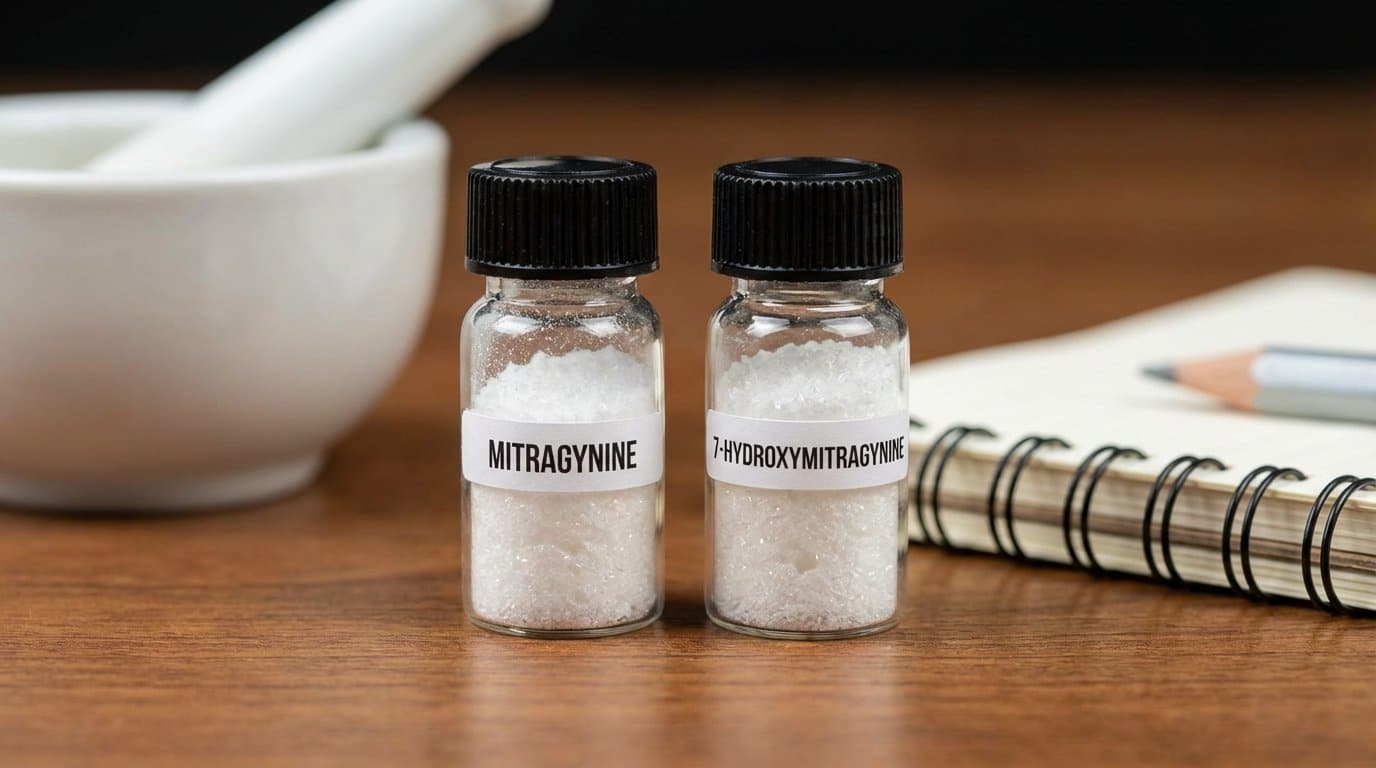
The critical distinction lies in chronic use patterns. Mitragynine’s terminal half-life exceeds 24 hours in regular users, while 7-hydroxymitragynine’s half-life increases dose-dependently. Both alkaloids persist longer than their acute elimination rates suggest, meaning your detection window extends well beyond initial clearance estimates.
How Your Body Breaks Down Kratom Alkaloids
Your liver’s CYP3A4 enzyme handles the primary metabolic workload, generating O-demethylated and mono-oxidative metabolites from mitragynine, with CYP2D6 and CYP2C19 contributing to secondary pathways. Kratom alkaloids follow a biphasic elimination process, an initial rapid distribution phase followed by a slower terminal elimination phase, which explains why mitragynine’s half-life can extend well beyond what its fast absorption (peak concentration within 90 minutes) might suggest. Your kidneys then clear the resulting Phase II conjugates, primarily glucuronide and sulfate metabolites, through urinary excretion over the following days.
CYP3A4 Enzyme Role
Because mitragynine must undergo extensive hepatic metabolism before your body can eliminate it, the liver enzyme CYP3A4 plays the central role in this process. CYP3A4 serves as the primary isoform responsible for mitragynine’s metabolic clearance, with smaller contributions from CYP2C9, CYP2C19, and CYP2D6. Importantly, CYP3A4 exclusively catalyzes the formation of 7-hydroxymitragynine, a potent active metabolite generated in vivo.
This enzymatic pathway directly influences the half life of kratom. CYP3A4 facilitates Phase I O-demethylation reactions at the C-9 and C-17 positions, producing key metabolites like 9-O-demethylmitragynine and 16-carboxymitragynine. Since CYP3A4 handles the predominant metabolic workload, any variation in your CYP3A4 activity, whether genetic, dietary, or drug-induced, can greatly alter how quickly you metabolize and clear mitragynine.
Biphasic Elimination Process
The terminal phase reflects slower final clearance after pseudo-equilibrium, extending the kratom elimination half life to roughly 23.24 hours (±16.07 hours). A high apparent volume of distribution prolongs this phase, while renal excretion accounts for only 0.14% of unchanged mitragynine.
Oral ingestion approximately doubles initial-phase clearance time compared to intravenous delivery, requiring around 33 hours for full systemic clearance. Your liver function, dosage frequency, and body composition directly influence both phases’ duration.
Metabolite Urinary Clearance
Before kratom alkaloids reach your urine, your liver metabolizes them through extensive Phase I and Phase II biotransformation. Your kidneys then filter these metabolites from blood into urine, with minimal alkaloids excreted unchanged. The half life kratom elimination profile means mitragynine remains detectable in urine up to 9 days post-ingestion. Understanding how long is kratom detectable for is essential for those subject to drug testing. Various factors such as dosage, frequency of use, and individual metabolism can influence detection times. Users should consider these variables to avoid potential complications related to kratom consumption.
| Biomarker | Urinary Detection Characteristic |
|---|---|
| Mitragynine | Primary alkaloid; detectable up to 9 days |
| 7-Hydroxymitragynine | Shorter detection window than mitragynine |
| Speciociliatine | Exceeds mitragynine concentration in unhydrolyzed urine |
| Speciogynine | Alternative biomarker exceeding mitragynine levels |
Notably, 3*R* alkaloids show a higher fraction excreted unchanged than 3*S* alkaloids. Acidic urine accelerates excretion rates, while proper hydration supports efficient renal flushing of metabolites.
How Long Kratom Shows Up on a Drug Test
How long kratom remains detectable depends on the type of test administered, the sensitivity of its cutoff threshold, and your individual metabolism. Because mitragynine’s kratom half life ranges from approximately 23 to 24 hours, full systemic clearance can take several days. How long kratom stay in blood will vary based on several factors, including frequency of use and dosage amounts. In occasional users, traces may be detectable for a few days, while chronic users could have kratom present in their blood for longer periods. It’s essential to consider these variables, especially in contexts such as drug screenings or health assessments.
Detection windows vary by specimen type:
- Urine: 2, 5 days for occasional users; up to 2 weeks for heavy users via LC-MS/MS at 1 ng/mL cutoff
- Blood: 1, 3 days, though mitragynine’s half life supports theoretical presence up to 9 days
- Saliva: 24, 48 hours, capturing the parent compound shortly after ingestion
- Hair: Up to 90 days via specialized LC-MS/MS analysis
Standard drug panels don’t target mitragynine. Only specialized tests using mass spectrometry can distinguish kratom’s alkaloids from opioids.
What Affects Your Kratom Half-Life the Most

Because kratom’s elimination rate isn’t fixed, several physiological and behavioral variables shift its half-life considerably, sometimes by a factor of eight.
Your metabolism ranks highest. Faster metabolic rates, driven by genetics, age, and CYP3A4 enzyme activity, accelerate mitragynine breakdown. New users often clear kratom with a half-life near 3 hours, while chronic users face accumulation that extends it toward 24 hours.
Dosage and frequency directly influence the half-life of kratom. Higher doses saturate hepatic enzymes, slowing clearance. Repeated use builds residual alkaloid levels, compounding elimination delays.
Liver and kidney function determine processing efficiency. Compromised hepatic activity reduces mitragynine conversion to 7-OH-mitragynine, prolonging systemic presence. Kidney impairment further extends excretion timelines.
Administration route matters too, oral ingestion yields a 6.6-hour half-life versus 2.9 hours intravenously.
Get Help Today Before It Gets Harder
Kratom has a way of becoming part of your daily life before you even realize it and walking away from it is harder than most people expect. At Santa Barbara Recovery Center, we provide Addiction Treatment with the care and support you need to heal and move forward. Call (805) 429-1203 now and walk toward a life that feels like yours again.
Frequently Asked Questions
Can Drinking Water or Exercising Speed up Kratom Elimination From Your Body?
You won’t notably speed up kratom elimination through water or exercise alone. Hydration increases urine output but doesn’t alter CYP3A4 liver metabolism, the primary pathway breaking down mitragynine. Exercise boosts circulation and sweating, minor elimination routes, but no clinical data confirms it reduces kratom’s half-life. Fat-soluble alkaloids bind to tissues, resisting both interventions. Your genetics, dosage, and use frequency outweigh these lifestyle factors, with detection windows persisting up to seven days regardless.
Does Kratom’s Half-Life Change if Taken With Food Versus Empty Stomach?
There’s no direct data comparing kratom’s half-life when you take it with food versus on an empty stomach. However, oral ingestion shows biphasic elimination and significant variability (7, 39 hours), suggesting gastric factors likely influence absorption kinetics. Since CYP3A4 handles hepatic metabolism, food could alter peak plasma concentration timing without necessarily changing elimination rate. You’d likely see shifted absorption phases rather than a fundamentally different terminal half-life.
Will Kratom Interact With Prescription Medications That Use the Same Liver Enzymes?
Yes, kratom can interact with prescription medications metabolized by CYP3A4, the same liver enzyme that breaks down mitragynine. If you’re taking CYP3A4 substrates like statins or benzodiazepines, you’ll face competition for enzyme access. This competition can slow kratom’s clearance, extending its half-life, or alter your medication’s metabolism. CYP3A4 inhibitors specifically prolong kratom’s elimination, increasing accumulation risk. You should consult your prescriber before combining kratom with any CYP3A4-dependent medication.
How Many Days After Stopping Kratom Do Withdrawal Symptoms Typically Begin?
You’ll typically notice withdrawal symptoms within 12, 24 hours after your last kratom dose. If you’re a light user, onset can occur as early as 6, 12 hours, while heavy or chronic users may not experience symptoms until 24, 48 hours post-cessation due to mitragynine accumulation and its extended terminal half-life. Symptoms peak around days 2, 4, with the acute phase lasting 3, 10 days and full resolution occurring within 5, 7 days for most users.
Is Kratom’s Half-Life Different in Older Adults Compared to Younger Users?
Yes, kratom’s half-life likely extends in older adults compared to younger users. As you age, your metabolic rate declines, and liver enzyme activity, particularly CYP3A4, which primarily metabolizes mitragynine, diminishes. This slower enzymatic processing means your body retains kratom’s alkaloids longer, effectively prolonging the half-life. While no direct age-comparative studies on kratom exist, general pharmacokinetic principles confirm that older adults experience delayed drug elimination, increasing both detection windows and accumulation risk.